Politics and Government Research Notes |
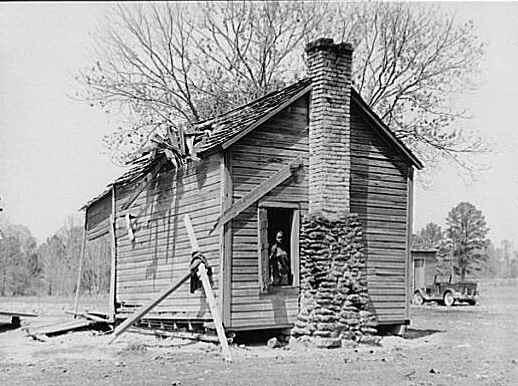
Cabin of Negroes living near Jefferson, Texas.
Politicians, Government Officials
An Act to incorporate the town of Jefferson.
An Act creating the county of Marion
| A post office was established in 1846, and the town was incorporated in March 20, 1848, though because of various delays a city charter was not adopted until 1850. In the same year the town adopted the aldermanic form of city government. In 1846 Jefferson became the county seat of Cass County, upon that county's separation from Bowie County, and served as such until Linden became county seat in 18521 |
| . |
| Jefferson Incorporation |
| . |
| In 1860 Jefferson became county seat of the newly established Marion County. 1 |
| . |
| Creation of Marion County |
| . |
| After Abraham Lincoln was elected, Marion County voted unanimously for secession.467 votes to non.1 |
| January 1, 1863 - Lincoln issues the Emancipation Proclamation |
| . |
| Granger was given command of the Department of Texas on June 10, 1865, by Gen. Philip H. Sheridan, commander of the Military Division of the Southwest. Upon his arrival in Galveston on June 19, he officially declared that the institution of slaveryv was dead, setting off joyful displays by Texas freedmen. For six weeks Granger took this message into the interior of the state. On August 6, 1865, he was relieved of his command and replaced by Gen. Horatio G. Wright.1 |
| .. |
| In the spring of 1867 the registration of black and white Texas voters under the Reconstruction acts began1 |
| . |
| The Texas Republican Party was formed on July 4, 1867, in Houston by 150 African Americans and 20 Anglos |
| An 1867 Oath from the Registers Office in Marion County, Texas for G. W. Lisenbee.1867 Aug 19 |
| Sep 1865 Freedmen's Bureau established in Texas Lt. Adam G. Malloy, stationed at Marshall in August 1867, was responsible for Harrison, Marion, Panola, Rusk, Davis, and Upshur counties.1 |
| . |
| Our Texas Correspondence by Magnolia Marshall Texas Dec 29, 1867newspaper |
| . |
| "Long 'bout the close of the war a big "Yankee" Camp was at Jefferson right where the old courthouse is now. They stayed there a good while. I stayed with the Fowlers till the Ku Klux got to raging. The "Yankees" run the Ku Klux out of business. That Ku Klux business started from big men trying to run the Niggers back to their farms. After surrender they most all left their masters and they got up the Ku Klux to try to run them back. The colored folks was skeered (scared) of the Ku Kluxers. They come round the house and had some kind of rigging fixed so they could drink several buckets of water. The Niggers hadn't ever seed nothing like that and was skeered of them. A colored man at Jefferson named Dick Walker got up a colored malitia to keep the Ku Klux off of the darkies. The malitia met here in Jefferson in the old African (colored) Methodist Church. My Master Henry Fowler help get up a bunch of about thirty men to break up the colored malitia. The whites organized on Fowlers place at Sulphur Springs. I help saddle most of the horses the night they went to take the African Methodist Church. Ben Biggerstaff was one of the main leaders of the whites. They killed several of the colored militia and wounded lots more. That was after the "Yankees" had left. Right after surrender, when the Ku Klux was raging,"4 |
| . |
| Freedman murdered August 26, 1868 |
| . |
| August 25, 1868. Marion County Chief Justice Campbell reports to Provisional Governor Pease about Ku Klux Klan activity in and about Jefferson |
| Marker Text: (April 5, 1813 - January 2, 1869) William Perry was among the first settlers of Jefferson, arriving ca. 1840. A respected community leader, he served as mayor of Jefferson from 1863 to 1864. On January 2, 1869, Perry was fatally shot while walking home after midnight. 2 |
| . |
| In spite of the intense passions engendered by Reconstruction politics, the county's prominent citizens were able to separate politics and financial necessity, opposing a proposed boycott of Republican businesses in 1869 and 1870. Few disliked the Republicans enough to refuse to do business with them.1 |
| . |
| Among the centers of Klan activity in the state was Jefferson and surrounding Marion County, where the small federal garrison under the command of Maj. James Curtis could do little to stem the terror. In October 1868 a band of Klan vigilantes killed George W. Smith,qv leader of the local Republicans, and a number of his black followers; for the next two months bands rode through the countryside burning houses and crops and beating and intimidating terrified blacks.1. |
| On October 4, 1869, George Washington Smith was murdered in Jefferson by a band of vigilantes. Smith's slaying led to the military occupation of Jefferson by Union troops under the command of Gen. George P. Buell, whose orders were to establish the security of citizens loyal to the United States and to arrest and try Smith's killers. The action taken by the military tribunal that followed was known as the `Stockade Case.1 |
| CRUMP, R. P., Col. |
| . |
| During the Reconstruction Mr. Hodge's brother was elected mayor of Jefferson, however he was removed from office by General J.J. Reynolds, Commander of the Fifth Military District U.S.A. army, for his failure to insure the safety of G.W. Smith, a Northerner who was murdered by a group of angry citizens. Forty prominent citizens were arrested and a military tribunal was convened which resulted in the infamous "Stockade Trials" of Jefferson. These lasted for a two year period2 |
| . |
| In 1869 the Eleventh Infantry was headquartered at Jefferson, Texas1. |
| .Texas Republican Party (Radical) Ballot: The 1869 Election |
| Anti-Radical Republican Ballot: 1869 Texas Gubernatorial Election |
| Stockade Case |
| Sentenced to Life by the Military Court in Jefferson5 |
| .. |
| Jefferson As It Was and As It Is Now5 |
| . |
| "I 'members when the colored folks run this town. A colored man, Paul Matthews , was County Judge and Bill Wisham was Sheriff. Then the colored people voted like the whites, but they got up the White Citizen's Party and cut the Negroes off."4 |
| . |
| With military protection afforded the black majority, the white Republican minority, through the use of the local Union League, took control of county government. Republicans continued to serve in county political offices through the decade of the 1870s. The restoration of white conservative rule, commonly called "redemption," did not come until 1882 with the election of a Democrat-dominated commissioners' court. However, despite violence and intimidation aimed at the black majority throughout the remainder of the nineteenth century, blacks continued to deliver Marion County's majority for the Republican presidential ticket until the white primary effectively disfranchised them in 18981 |
| . |
| Dan James a
constables of Marion County received a prison sentence
for horse theft. p.913 |
| . |
| The election of
Negroes to office often created problems. The election
machinery frequently broke down and the maintenance of
local government became difficult because of the
inability of elected Negroes to qualify for office. Most
Negro officials were unable to post sufficient bond
themselves and found it difficult to secure white
sureties. In 1874,for example, Marion County elected five
justices of the peace, four of them Negroes; none
could post satisfactory bonds. A new election, almost as
unsatisfactory, left the county with only one justice who
could qualify. p. 88 |
| . |
| Marion County in 1876
had three Negro county commissioners, p.93 |
| . |
| From this point on, county voters returned a majority for Democratic presidential candidates in every election through 1992 except in 1956 and 1984.1 |
| William E.
Singleton served, variously, as sheriff of Harrison
County, Deputy United States Marshall and District County
Clerk of Jefferson, and United States Commissioner. The Singleton family continued to be prominent in Jefferson society long after the death of William Singleton. William E. Singleton, Jr., for example, served as postmaster of Jefferson and managed a lumber manufacturing company. He was particularly well known for his work in helping to organize the Republican Party in Texas2. |
Sources: |
|
| 1 | Handbook of Texas Online website. |
| 2 | Texas Historical Commission web site. |
| 3 | The Negro in Texas |
| 4 | Lee Pierce's slave narrative |
| 5 | |