Historically Black College

J. R. Reynolds, elected principal of Gilbert Academy
A CAPTAIN OF INDUSTRY IN THE FREEDMEN'S AID WORK. By Prof. S. S. Reid, Wiley University, Marshall, Tex.
This man is James R. Reynolds. He was picked up years ago by a Freedmen's Aid teacher In the State of North Carolina and sent to Bennett College, where he was fitted for his life's work. What this young man has done at Wiley University is just what other young Negroes can do if you give them an opportunity. Without any preparation in industrial work he has schooled himself in several lines of industry and has successfully taught them to the students at Wiley University, until to-day this department is second to none in any of the schools of the Freedmen's Aid Society.
It has been now nearly ten years since Prof. J. R. Reynolds came to Wiley University to teach mathematics. It was just on the eve of the great building era introduced by President M. W. Dogan, the successful President. Of this energetic and courageous man it could be said that he is the Caesar Augustus of Wiley University, not that he found It brick and left it marble, but that the improvements he has made form quite as great a contrast.
President Dogan desired that the buildings which he should add to the University equipment should be modern In every way, heated by an up-to-date system, and lighted by electricity. This difficulty at once confronted us, How can we get the electrical connections?
INSTALLS AN ELECTRIC-LIGHTING PLANT.
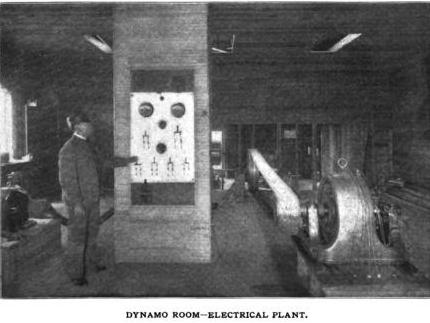
The city light and power company thought it unprofitable to extend their lines out to our place and that seemed to settle the lighting part of the president's plans. It was then that Prof. Reynolds began his role as a captain of industry. Determining to put in a private plant for lighting the buildings, he organized the more energetic of his pupils for the purpose of raising funds and began experimenting with electricity.
After two years of study and experiment a small lighting plant was installed, which has grown by leaps and bounds, keeping pace with the rapid growth of the University, till now our lighting plant has a capacity of twenty thousand watts and can light up the thirteen buildings and campus, furnishing current for power purposes and still the meters show that the load is not over sixty per cent of the electric capacity.
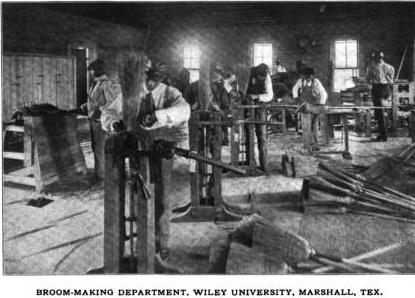
OPENS A BROOM FACTORY. In order to furnish employment to many students who could only come to school If they be given opportunity to work their way, and also to help out matters of operation, Prof. Reynolds began looking around for an article of steady demand which could be made by the students. Having chosen the common household broom as the article to be manufactured, he sent one of his pupils to Austin to learn the business. A broom machine was purchased, also a small lot of supplies. At first brooms were made for the school, then for the town merchants, till finally large numbers of brooms are shipped to different points of Texas and the adjacent States. Twenty-five dozen brooms and brushes were sold at the recent session of the Texas Annual Conference.
INVENTS A BROOM MACHINE. Not having money enough to buy but one broom machine, it was planned to build as many as might be needed in the machine shop. Carefully the patterns were worked out in wood, the parts were cast into iron by the city foundry and a number of these home-made machines are at work in the broom factory doing equal service with the one which was bought. In fact, his machines have a little Improvement In the wire-feeding device, and the handle-holding device— his own invention—is well up to the standard.
During the last year a fine crop of the very best of broom corn was grown on the college farm, demonstrating possibilities never before dreamed of. A beautiful calendar for 1908, illustrating the different stages of broom-making, from the sowing of the seed till the last stitch is sewed, containing a tiny hat brush and withal a unique combination, will be sent to any one who sends twenty-five cents to pay expense of boxing and maling.
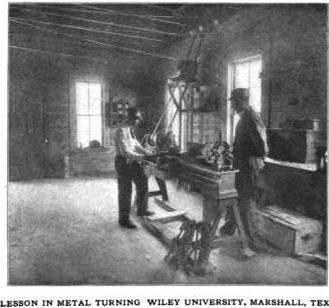
SETS UP A MACHINE SHOP. There was urgent need of a small machine shop In which the repairing could be attended to. Piece by piece certain machine tools and supplies were added, till now the largest lathe can swing the armature of the largest dynamo and re- bore the engine cylinders. Only the addition of a blacksmithing outfit is needed to bring the equipment up to the demands made upon it.
SOME OF THE METHODS USED.
Sawing wood by machinery for seventy- five cents per cord, laboriously working out a key for a college algebra, selling electricity at less than the competing lines, Issuing bonds in times of financial stringency, giving entertainments, at which the refreshments would be donated by friends, soliciting subscriptions from students and others in sums of a dollar or more, all these and other methods were used with great success.
WHERE THE MONEY CAME FROM.
Any one going through our machinery building and noting the first-class machines and efficient tools would be surprised to learn that there has never been a fund for the carrying forward of this work and that by a dozen different methods Prof. Reynolds has raised funds and built an establishment conservatively valued at ten thousand dollars.
The last money, two thousand five hundred dollars, which paid for the recent installation of lighting machinery, came from nobody knows exactly where It seems. Dr. M. C. B. Mason, Corresponding Secretary of the Freedmen's Aid Society has always been a stanch friend of our work, coming to the rescue when it seemed all was lost and by his lectures interesting friends in the North. He It was whose advice and encouragement made the work possible, and he is no doubt responsible for the financial success of Prof. Reynolds.
HOW ONE DOLLAR WAS MADE TO BUY TWO DOLLARS' WORTH. It should also be stated that the head of Wiley's industrial department has the rare faculty of spending a dollar to the best possible advantage. A heart-to- heart talk with the manufacturer, in which the great need of our work was contrasted with its poverty of means, always gained a large discount from the purchase price—alas! was this rebating? —with payments by installments and oft- times donations of machinery by kindly disposed dealers.
A GOOD TURNING LATHE FOR $2.50.
Another method of procedure was to buy up for a song—so to speak—a broken or discarded machine and then with rare mechanical genius to rebuild and repair It to its normal condition. An old lathe covered with grease and dust stowed away in a dark corner was purchased from the saw-mill owner for $2.50. Rebuilt and fitted with a new taper spindle it has done the work of a fifty-dollar tool in our wood-work department for nearly five years. A manufacturer from whom a small dynamo was purchased gave also two motors which he said were of no use to him, being very defective. These motors have been rebuilt and have done the work of new machine.
MAKES ELECTRICIANS AND MACHINISTS OUT OF COUNTRY BOYS. It is wonderful how a great necessity creates a workman to supply the need.
Not once has it been necessary to call in an outside machinist or electrician to adjust our machinery. Boys reared on the farm and knowing little of machines have come into the shop and under the stress of a great need have wired buildings. Installed machinery, and what is of greater difficulty, kept the same in running condition.
Mr. George A. Palmer, the college electrician, came into the department six years ago thinking that electricity flowed through pipes like water. Not quite a year passed before George built a small dynamo which successfully ignited the charge of a gasoline engine. After a while be built a steam engine, then a gasoline engine. Now his genius meets and overcomes every problem of steam, mechanical, or electrical engineering with which we have to deal. Prof. Reynolds says of him, "He has been to me what Friday was to Crusoe; to no ctbei pupil could I discuss the problems with which I was dealing with any sort1 of a chance of being understood."