Historically Black College

Boley Electric Light Company
Last summer the industrial department at Wiley University, Marshall, Tex., performed almost a miracle in setting up and putting in good running order an electrical plant in Boley, Okla., a thriving town of about 3,000 inhabitants, with not a single white resident. The colored people also own the adjacent fine farming territory within a radius of from six to twelve miles. Negroes administer all the town offices as well as the post office. The railroad company employs a Negro ticket agent, freight agent, and telegraph operator. Here also the first colored girl on record manipulates the switchboard of a local telephone company. There are many substantial business concerns, handsome residences, and a visitor to the town is struck by the prosperous condition of the citizens.
The whole town is permeated with a high moral tone, and is anxious to make good proof of what the Negro can do in self-government. Recently a colored man who had been accused of crime in an adjoining county attempted to take refuge in Boley, but he was locked up and returned to the town where he was wanted, with the distinct understanding that Boley would not be a refuge for any man accused of crime.
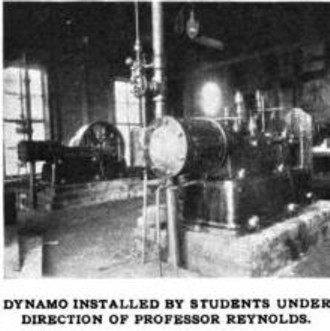
Mayor Haynes contracted with Professor Reynolds of Wiley University to install an electric system in Boley. Professor Reynolds, himself a graduate of one of our schools, took with him three of his young engineering students— George Palmer, Theodore Jacobs, and Charles Thrash. Palmer, who is a mechanical genius, was the first student in the engineering department at Wiley.

Professor Reynolds found many people with whom he had to deal doubtful whether he and the three Negro boys with him were able to do the necessary mechanical and electrical work for the installation of the system. Even manufacturers hesitated to sell him complicated machinery, because they thought he and his boys were unable to operate it. Negroes themselves were doubtful as to what would finally be the outcome.
One old colored aunty, passing by and seeing one of the young men perched high on the top of a pole, adjusting a transformer, said, "Honey, is you done said you pra'rs dis mawnin'?" Receiving no answer, she continued, "Bless my soul, de good Lawd done took all de fear out of dat chile's heart, so dat he could come here and give us de light."
All through the summer, notwithstanding the difficulties, these young men toiled on. They worked as if they thought the honor of their institution and of the Freedmen's Aid Society depended upon their work—as, indeed, in some measure it did. One after another the problems of construction were met and overcome, and by September 1st the plant was fully installed and the city lighted.
Mr. Palmer has been placed in charge of the system as superintendent, the first colored man in such a position in the United States.
Mayor Haynes, in a letter to President Dogan, says:
"We now have installed a lighting system which visitors from towns of ten times our population acknowledge to be fully up to the standard and in many cases superior. All are willing to give Professor Reynolds credit for being master of his profession, a man who does things in a quiet, unassuming way, calculated to win the confidence of all with whom he comes in contact. We are proud of our system, and appreciate the fact that we represent the only Negro town in the world which is lighted by a commercial electric system owned, installed, and operated by colored men."