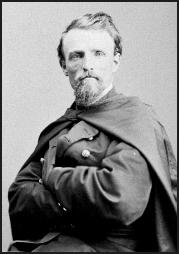
Lieutenant-Colonel George P. Buell, Eleventh Infantry


George Pearson Buell


BREVET BRIG.-GENERAL GEORGE P. BUELL.

Buell.—Died, in Nashville, Tenn., May 31, 1883, George P. Buell, late Colonel Fifteenth United States Infantry, and Brevet Brigadier-General U. S. Army, aged 49 years, 7 months, and 27 days.

George P. Buell was born in Dearborn county , near Lawrenceburg, Indiana, October 4, 1833. He was the second son of George P. and Ann Lane Buell, His early days were spent at his father's home, where he had the means of private instruction—supplemented by attendance at school at Lawrenceburg. On leaving school, he entered Greencastle College, in his native State—and then, in 1855, when twenty years old, he was sent to Norwich Military University, in Vermont. Here he pursued a scientific course of study, and was graduated in 1856. Soon after his graduation, he went to Leaven worth, Kansas, where he was made City Engineer. This position he held for about two years. It was a time of high political excitement—in which, of course, he could not help sharing. His efforts and influence were always exerted to secure the purity of elections, and to take care that none but bona fide citizens of the State should vote.

In the spring of 1859 he went to Colorado—his first work there being to survey and superintend the construction of the first ditch dug in Central City. He was afterward engaged in mining in California Gulch—where Leadville now stands. Here he was when the War of the Rebellion began. Returning to his native State, he offered his services, which were accepted; and, on December 4, 1861, he was commissioned Lieutenant-Colonel of the Fifty -eighth Indiana Infantry. This regiment soon moved into Kentucky, and was assigned to the Sixth Division, Army of the Ohio, under command of General T. J. Wood. Its first duty was trying to open the way into East Tennessee. In helping to re-build the roads through that difficult region, Colonel Buell had his first lessons in this important work, for which his brigade was afterward so distinguished. Moving to Nashville with the Army he reached there about the first of March; and, in due course, went on to Shiloh—but the division came upon the field too late to take part in the battle.

With the division, Colonel Buell went through all the marches and hardships of the campaign against Corinth. On the 23d of June, 1862, he was promoted to the Colonelcy of the regiment. He was with it in the march to Decherd, Nashville, Louisville, and Perryville— thence back to Nashville toward the close of November. In the fierce and bloody struggle of Stone's River, which soon followed, Colonel Buell took an active and gallant part, having for the first time an opportunity to show his ability in actual battle. His regiment belonged to Hascall's brigade, which held the extreme left of the Union line-of-battle. In the fiercest of the fight, he was ordered to relieve a regiment which had become exhausted by the long and hard conflict. Coming to the assigned position promptly, and in the most gallant manner, he held the ground against all efforts to dislodge him—losing over one hundred in killed and wounded. Later, he was sent to the assistance of Palmer's division, which was sorely pressed. How well he did his work here, is shown by an extract from General Wood's report: "The regiment got into position, reserved its fire until the enemy was in close range, and then poured in a withering discharge, from which the foe recoiled in disorder." General Palmer, also, recognized this important service—saying, in his report: "One regiment was sent to my support, from General Wood's command, which behaved splendidly."

In the advance upon Chattanooga, in the following autumn, Colonel Buell was among the first to enter the town. At the battle of Chickamauga, which soon followed, he commanded a brigade. In the first day's fight, he was subjected to a terrific attack from the enemy, before which, for a moment, his brigade gave way; but, by the efforts of himself and others, it was quickly rallied, and soon recovered all its lost ground, and maintained its position. In this action, Colonel Buell showed great energy and courage. His horse was shot under him, and, in falling, he received an injury to his hip, from which he never recovered. His own regiment, the Fifty-eighth Indiana, lost 171 men in this battle; and the other regiments of the brigade in lighter proportion.

lu the reorganization following Chickamauga, Colonel Buell was assigned to Wagner's brigade, Sheridan's division—and with it shared in the glorious assault on Missionary Ridge. Moving to Knoxville, he passed the winter in the comfortless camps in East Tennessee. Here, the regiment, with Colonel Buell at its head, re-enlisted in January, 1864, and went home on veteran furlough. On his return from Indiana, a special brigade was organized for him, called the Pioneer Brigade. It consisted of Colonel Buell's own regiment (the Fiftyeighth Indiana), with two other battalions of pioneers, and a pontoon battalion. This brigade reported directly to the Army Commander, and was intended to do all the work which its name implies; i.e., build roads, bridge streams, clear the way of all obstructions, and generally make itself useful in all ways in which an advancing army might require it. This position was exactly suited to Colonel Buell's ingenious, energetic, and restless temperament. Under him, the Pioneer Brigade became one of the most useful and efficient bodies of men in the whole Army—equally capable, and ready, to work or fight, as occasion might demand.

Its first duty was the building of a macadamized road over the point of Lookout Mountain, connecting Lookout Valley and Chattanooga. When completed, the road gave direct overland communication with Bridgeport. In the organization of the Grand Army for the Atlanta campaign, Colonel Buell was placed in charge of the pontoon train; and, throughout the campaign, it is doubtful if the movements of the army were ever delayed a single hour by reason of any lack of energy or efficiency on his part. Wherever needed, the streams were bridged in an incredible short time. No small part of the success of the Army movements, in their flanking operations, was due to his skill and readiness in this important branch of the service. In the March to the Sea, Colonel Buell continued in command of the Pioneer Brigade, and with equal success. It was partly in consequence of his quickness in bridging the Ogeechee, that the assault on Fort McAllister was made possible—thus giving General Sherman the key to the capture of Savannah. For his success, Colonel BuEll was made Brevet Brigadier-General on January 12, 1865.

At Savannah, the Army was again reorganized, and General Buell was assigned to the command of a brigade in the First Division of the Fourteenth Army Corps, with his brevet rank. This brigade he commanded to the close of the war. At the battle of Bentonville, on March 19, 1865, he was sent to the left, to develop the enemy's line. In ignorance of the fact that Johnston had concentrated his entire Army at this point, the Union troops were widely scattered. General Buell soon came upon the rebel works, which he vigorously assaulted ; but, almost immediately, found his own front and flank attacked with an overwhelming force, before which he was compelled to retire. Other troops, however, soon came up; and so expertly had General Buell carried out his orders that the enemy were unable to accomplish their object. Before his disordered line could be readjusted, such disposition was made as enabled the Fourteenth Corps to hold its own. This vigorous action saved Sherman's left wing from being defeated in detachments. In this action General Buell had three horses shot under him. The battle was the last armed encounter between arms of the infantry force of the Army of the Cumberland and the enemy.

General Buell was mustered out of the volunteer service July, 25, 1865. He at once embarked in cotton planting in Georgia ; but was unsuccessful. A year later, on the reorganization of the Regular Army, he was, without his application, or any knowledge on his part, on July 28,1866, commissioned Lieutenant-Colonel of the Twenty-ninth Infantry. It was some months after his appointment before he learned of it—and then by accident. He at once accepted, and entered upon his new duty, at Lynchburg, Virginia. In 1868, the regiment was ordered to Texas. Most of his subsequent life was passed on the frontier, and in presence of the Indians. In March, 1867, he was appointed Colonel, and Brigadier-General by brevet, for his gallant and meritorious services during the Rebellion. On the reduction of the Army, in 1869, he was transferred to the Eleventh Infantry; and, on March 20, 1877, was promoted to be Colonel of the Fifteenth Infantry. This position he held at the time of his death.

Of all General Buell's services, it is, of course, impossible to speak. He was, except an occasional leave of absence, in consequence of impaired health, continually on duty — mostly in Indian warfare, in various parts of the country, from Dakota to New Mexico. One of his expeditions had such important results, that it deserves mention. In the autumn of 1880, while his command, the Fifteenth United States Infantry, was stationed in New Mexico, a band of Indians, under the leadership of the notorious Victorio, was committing all sorts of depredations, both in Mexico and the United States. The people of Southern New Mexico were seriously disheartened by the success of the Indians, and the failures of the expeditions that had been sent out against them. When General, Buell took command, he had not only to conduct in such way as to secure the moral support of the citizens of New Mexico, but also to win the good will of the Mexican authorities, and, if possible, their permission to follow Victorio across the border, into the neighboring Republic. Having succeeded in bringing about both these results, he took the field with a command of about 800 troops, and so vigorously followed up the hostile chieftain as to drive him into the mountain regions in the State of Chihuahua. Here a body of Mexican soldiers attacked Victorio, and compelled his surrender — thus ridding that country of a most formidable foe, and bringing about assured peace.

These severe labors seriously injured General Buell's health, and he was scarcely afterward fit for fort duty. In the autumn of 1881, he was sent to Colorado ; but the severity of the climate greatly aggravated the trouble from which he suffered, and, in March, 1882, he was compelled to apply for a leave of absence — from which he never returned.

General Buell's services are briefly outlined in this imperfect sketch. He was a man of uncommon vigor and activity, both of mind and body. His countenance was striking and impressive. Of an ardent temperament, quick, energetic, decided in thought and action, he was always ready to undertake any enterprise on which he might be ordered—and he could be relied upon to carry it out with energy, vigilance, and courage. He was fertile in resources, full of ingenuity, not daunted by difficulties or obstacles. His heart was warm, sympathetic, affectionate. These qualities enabled him to accomplish many things, in many directions; gave him self-reliance in emergencies; and made him friends and admirers every-where. In his private relations, he was strong in his friendships, and honorable and prompt in all his dealings.

He was married on December 27, 1865, to Miss Rochie Brien, daughter of Judge John S. Brien, of Nashville, Tennessee. He leaves one child, a son—Don Carlos Buell—recently appointed a Cadet in the United States Military Academy at West Point.

Reunion of the Society of the Army of the Cumberland - Page 224

 - 1886 


16. Eleventh infantry, to be composed of the 24tA and 29fA regiments.—The 24th and 29th regiments, in the department of Texas, will be consolidated for service in that department, and will hereafter be known as the llth infantry. The field officers will be—Alvan C. Gillem, colonel; George P. Buell, lieutenant colonel; Lyman Bissell, major.

Annual report of the Quartermaster General of the operations of ... - Page 34

United States. Quartermaster General's Office - 1869 


Home