Historically Black College
Wiley College
 IN the
northeastern corner of the State of Texas is Marshall, a city of about
fifteen thousand population. On an eminence at the outskirts of this
city, and within convenient walking distance of the center of the town,
lies the campus of Wiley College. This beautiful spot is one of which
the Board of Education for Negroes, of the Methodist Episcopal Church
and the local school authorities are justly proud. Beautiful shade
trees, well-trimmed hedges neat shrubbery, well-kept lawns, and
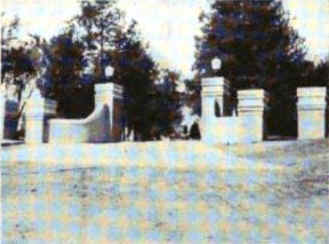
appropriate buildings set off the twenty-five acres of school property
which are devoted to school uses and make of it a campus to be admired.
The balance of the sixty acres owned by the school is used for
agricultural purposes.
IN the
northeastern corner of the State of Texas is Marshall, a city of about
fifteen thousand population. On an eminence at the outskirts of this
city, and within convenient walking distance of the center of the town,
lies the campus of Wiley College. This beautiful spot is one of which
the Board of Education for Negroes, of the Methodist Episcopal Church
and the local school authorities are justly proud. Beautiful shade
trees, well-trimmed hedges neat shrubbery, well-kept lawns, and
appropriate buildings set off the twenty-five acres of school property
which are devoted to school uses and make of it a campus to be admired.
The balance of the sixty acres owned by the school is used for
agricultural purposes.
BUILDINGS
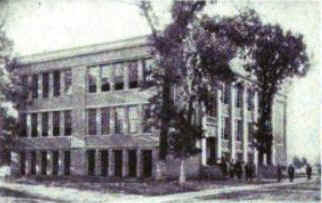
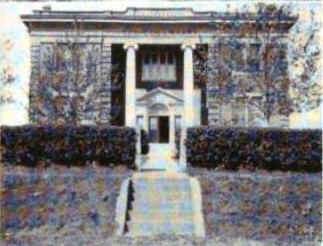
The main building, standing in the center of the campus, is a new structure made possible by the Centenary. It is modern in every respect. It is used for classroom and office purposes. The recitation rooms and laboratories are commodious, clean, properly lighted, and well equipped. A moderate-sized auditorium is also included. Two boys' dormitories stand nearby, and a little farther away stands the large dormitory now used, temporarily, for the girls. This building was designed for the use of the boys, but the girls have taken it over since a fire destroyed their dormitory. At the other end of the campus is the beautiful Carnegie Library, for this is one of the places where Mr. Carnegie saw fit, after careful investigation, to make a generous gift for a library building. Fortunately there is a large auditorium on the second floor of this library, which has been used for chapel purposes since a fire destroyed the old chapel. The president's house and other buildings, including a new and modern refectory, complete those on the campus itself. Not far away is King Home, the Industrial Home conducted by the. Woman's Home Missionary Society of the Methodist Episcopal Church; and in the neighborhood are comfortable homes of Negroes, many of whom are graduates or former students of Wiley.
HISTORY OF THE SCHOOL
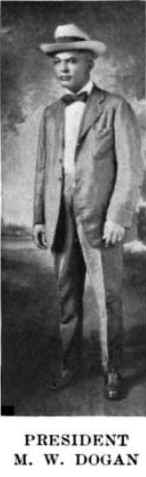
Wiley College was founded in 1873 by the Freedmen's Aid Society, and was chartered in 1882. The site first secured was thought to be too far from the city, so the present location was chosen. Bishop John M. Walden and Dr. R. S. Rust were closely identified with the school in the early days. Dr. Rust, with the assistance of the local board of trustees, selected the site and planned the buildings. During the early days of the school white men from the North were in charge, but in 1894 the Rev. I. B. Scott, now retired Missionary Bishop from Africa, became the first Negro president of the school. Two years later he was elected to the editorship of the Southwestern Christian Advocate, and Matthew W. Dogan, another colored man, became president of Wiley. Under President Dogan's energetic and efficient leadership the school has not only grown in size and in physical equipment, but it has also steadily raised the standard of its work. An excellent college department is maintained, and graduates from it are entitled to teacher's certificates in most of the Southern States without examination.
PRESIDENT DOGAN
President Dogan was born in Pontotoc, Mississippi, in the year 1863. When he was six years old the family moved to Holly Springs. There the boy entered the primary grades of Shaw University (now Rust College). Going to school, blacking shoes, and otherwise assisting the family, he grew up, and in 1886 graduated from Rust. He taught mathematics at his Alma Mater until 1890, when he was called to take charge of the Department of Mathematics at Central Tennessee College. There he remained until 1896, when he was made president of Wiley. In June, 1921, President Dogan completed a quarter of a century of service at Wiley, and there is much to show for his labors. From the first he threw himself wholeheartedly into his work, getting out among the people, eating and sleeping in their homes, meeting the young men and women, and securing not only students but also the loyal support of the colored people in his territory. At the same time he has so conducted himself and his work that he has commanded the respect and the cooperation of his white neighbors.
DEPARTMENTS
In addition to the College of Arts and Sciences the school offers a pre-medical course, a preparatory course, a normal course, a business course, and instruction in various musical branches. Under the direction of the Woman's Home Missionary Society thorough courses in domestic science and domestic art are given. This work is carried on in the new college building. The total enrollment of the school is about six hundred, and one hundred and twenty-five of these are enrolled in the College Department. This department is one of the most successful to be found in any of the schools. The relatively favorable educational situation in Texas partially accounts for this. The percentage of illiteracy among Negroes in Texas is distressingly high, but, compared to other Southern States, the situation seems quite good. While in some Southern States there are almost no public high schools for Negroes, there are a number of such schools in Texas from which pupils may go on to college. This situation is a distinct asset to Wiley in building up its College Department.
SUMMER SCHOOL
For some time a summer normal has been maintained at Wiley. Under a new plan now in operation a regular summer school is maintained in addition to the summer normal. In other words, the school year is divided into four quarters, at the beginning of any one of which pupils may be regularly enrolled. The school plant thus comes into almost continuous operation the year around, and during, that portion of the summer when the normal school, held in cooperation with the public-school authorities, is in session, it accommodates two schools. Each spring there is also held at Wiley a training school for Negro rural pastors, conducted under the auspices of the Department of Rural Work of the Board of Home Missions and Church Extension of the Methodist Episcopal Church. Thus the influence of the school is extended, and the physical equipment put to the most effective use.
THE FACULTY
The school has a faculty of more than twenty teachers representing training at Rust College, Wiley College, Harvard University, Fisk University, the University of Chicago, Howard University, Walden College, the University of Illinois, the University of Iowa, Virginia Union University, the Student University of Paris, the Armstrong Commercial School, Chicago Music School, Oberlin Conservatory of Music, and Wilberforce University. All of the members of the faculty are colored. Five of them give their entire time to college teaching.
STUDENTS AND STUDENT ACTIVITIES
The
students at Wiley come chiefly from Texas, Louisiana, Oklahoma, and
Arkansas, although they come from as far West as Arizona and California
and also from various Eastern States. They come from a great variety of
homes, but many come from the little corn and cotton farms of Texas.
Altogether they are an alert lot of young Americans. They maintain
numerous athletic organizations which make good use of the fine athletic
ground on the campus, and they have various student societies, including
the Y. M. C. A. the Y. W. C. A., the Epworth League, the Mason Literary
Society, Scott's Literary Society, the Francis Harper Literary Society,
the Reader's Club, the Friends of Africa, the University Debating Club,
the Phi Beta Sigma Fraternity, the Theta Gamma Epsilon Sorority, and
other organizations.
Many of the pupils are working
their way through school. Some work in hotels and restaurants, some in
banks or stores, some in private families. During the summer vacation
they go back to the farm; engage in construction work; teach school; go
North; or engage in other occupations. In the Pullman service they may
be found as far West as the Pacific Coast.
ALUMNI
The alumni of Wiley are doing good work in the world. They are filling a great variety of positions, but there are many teachers, high school principals, lawyers, doctors, and dentists. Dr. Emmett J. Scott, for many years associated with Booker T. Washington at Tuskegee, and now secretary, and treasurer of Howard University, was educated at Wiley; also Professor Willis J. King of Gammon Theological Seminary. The pupils at Wiley have manifested a particular interest in medicine and dentistry; many have gone on from here to study at Meharry and some to Gammon Theological Seminary.
NEEDS
Wiley College has a record of achievement of which to be proud, but its very success has created new demands. There are some immediate needs, such as a girls' dormitory, which must be supplied, but the outstanding need of the hour is for a large and substantial endowment. So important a school can hardly continue to hold its place and do its work in the world unless its future is assured by a generous permanent endowment. Wiley College has proved her right to live, and she must now be given a chance to live adequately. It would not be easy to find an institution more worthy or better prepared to make wise use of a large permanent investment than Wiley College.
Image1: Entrance to Campus
Image2: The Main Building
Image3: A Boys' Dormitory
Methodist Adventures in Negro
Education:
by Jay Samuel Stowell, 1883-1966.
