Historically Black College
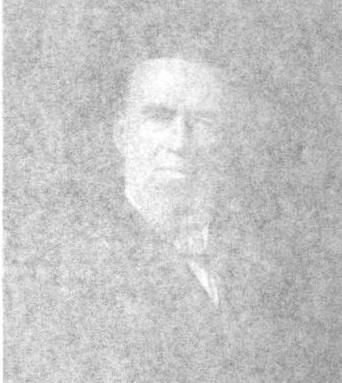
George Whitaker
THE career of a Methodist minister is one of much variety. If he lives to an advanced age he has labored in many places, under varied conditions, and his influence is beyond his finding out. While in this part of the world the itinerary system has given way to more settled pastorates, and the time limit is extended and is more conditional upon circumstances, the period of residence is still usually restricted, and the terms of service in one place are brief. The life of George Whitaker is the portraiture of a typical and creditable minister of the great Methodist Church.
George Whitaker was born in Boston, Massachusetts, May 14, 1836. His father was born in Sharon, Massachusetts, August 27, 1807, and he died November 10, 1883. His mother was Catherine Cravath Holland. His grandparents were Rev. Jonathan Whitaker, born 1771, died 1835; and Mary Kimball Whitaker, and on the mother's side, Captain John Holland, 1758-1824, and Sarah May Holland, 1772-1849.
The father was a dry goods merchant and afterward a clerk in the Boston Custom House, auditor of New Orleans Customs, and clerk in the Treasury Department at Washington, D. C. He was a reader of good books, a man of religion, a reformer, a good writer and speaker, an enterprising, generous and public-spirited man. An account of his life is given in the History of Norfolk County, Massachusetts. His ancestors were Saxon in origin. Jonathan Whitaker was born in England in 1690, and came to Connecticut, then to Long Island and New Jersey. John Holland is believed to have been the grandson of John Holland of Dorchester, England. John May was born in England in 1590, and died in Boston, Massachusetts, April 28, 1670. The great-grandfather of George was Rev. Nathaniel Whitaker, a noted pastor of the Tabernacle Church in Salem, Massachusetts, during the war of the Revolution. Before that he raised in England funds for the founding of Dartmouth College. Deacon Samuel May, of Boston, was the brother of George's grandmother, and a successful and respected merchant.
George Whitaker was brought up on a farm where he was industrious and had much useful discipline. He learned to make a prudent use of his time, and gained good health and a robust constitution. The influence of his mother upon his character was strong, although she died while he was yet a boy. The family resources were limited so that it was not easy for him to obtain the education he wished; but he was fond of reading in a general way, especially of the biographies of successful men. Among other books he had the Life of John Wesley, George Whitfield, and Marshall's Life of Washington. He read the History of Methodism and Watson's Theological Institutes. He studied in the West Newton Model School, the Bridgewater Normal School, the Wesleyan Academy at Wilbraham, the Wes- leyan University in Middletown, Connecticut, where he received the degree of Bachelor of Arts in 1861. He was a member of the Phi Beta Kappa and the Phi Nu Theta fraternities. He was made Master of Arts in 1864, and a Doctor of Divinity at Fort Worth University, Texas, in 1888. He joined the New England Annual Conference of the Methodist Episcopal Church in 1861, and became pastor at West Medway, Massachusetts. He chose his profession from a sense of his duty " to preach the Gospel."
He has especially felt the influence of the many men with whom he has been associated, but he knows also the influence of his home, his schools, his private study and his early companions. He has been president of Wiley University, Marshall, Texas, 1888-90; president of Willamette University, Salem, Oregon, 1891-92; president of Portland University, Portland, Oregon, 1899. He has- been a pastor at West Medway, 1861-62; South Walpole, 1863-64; Roxbury, 1865-66; Lowell, 1867-69; Westfield, 1870-71; Lynn, 1872; East Boston, 1873; presiding elder, Springfield District, 1874-77; pastor at Ipswich, 1878; Cambridge, 1879-81; Somerville, 1882-84; Worcester, 1885-87; Portland, Oregon, 1893; Detroit, Michigan, 1894- 96; Beverly, Massachusetts, 1897; Cambridge, Massachusetts, 1898- 1905; Lowell, 1905-06; Orient Heights, 1907; Linden, 1908.
He was a member of the school committee in South Walpole, and he has given many lectures and addresses in connection with Methodist institutions and churches and on various public occasions. He has been one of the Sons of Temperance, a Good Templar,
of the Temple of Honor, is a Free Mason, a member of the Evening Star Chapter of Westfield, Massachusetts. He belongs to the Republican party. He has found recreation in reading and fishing; in travel, croquet and boating; in civil engineering.
He married June 22, 1861, Harriet, daughter of George H. and Huldah Woodruff Clark, a granddaughter of Lemuel and Hubbard Clark and Eben and Rhoda Coe Woodruff, a descendant of William Clark, who came from England to Dorchester, Massachusetts, in 1636. They have had four children. There are now living, George Edgar, publisher of Zion's Herald, Boston; and John Holland, reporter and correspondent of the daily press in Singapore, Straits Settlements.
His counsels to youth, — obedience to parents, faithful study of books, and entire consecration to the service of God and man. He advises a wise choice of a field of labor, and an earnest effort for self-improvement and a wide influence for good, which will fill the years with an accumulating beneficence. His long and faithful life enforces his counsel.
Biographical history of Massachusetts:
by Samuel Atkins Eliot - 1911