Historically Black College
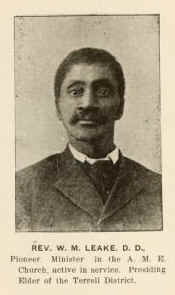
REV. W. M. LEAKE. D. D.,
Pioneer Minister in the A. M. E. Church, active in service. Presiding
Elder of the Terrell District
Sketch from Negro Education: A Study of the Private and Higher Schools
PAUL QUINN COLLEGE. President: J. K. Williams.2
An institution of secondary grade with a large elementary department and a few pupils studying college subjects. The liberal support of the institution by the colored people is noteworthy. The school was established and chartered in 1881 by the Texas Conference of the African Methodist Episcopal Church and is owned and controlled by an unwieldy board of trustees elected from the various conferences of the church throughout the State.
Attendance.—Total, 286; elementary 213, secondary 57, in college subjects 13, special students 3. Of the pupils above the grades, 63 boarded at the school.
Teaclters and workers.—Total, 15 ; all colored ; male 9, female 6, grades 1, academic 10, carpentry 1, agriculture 1, matrons 2.
Organization.—Only one regular teacher is assigned to the elementary grades. The catalogue shows a confusing arrangement of higher courses too elaborate for the number of pupils and too extensive for the teaching force. The pupils in the so-called normal and college preparatory courses are studying low-grade secondary subjects. Their spelling and handwriting indicate inadequate preparation for their classes. The 13 college pupils were taking language and mathematics courses too advanced for their preparation. A few of the pupils receive training in woodwork, printing, gardening, cooking, and sewing.
Financial, 1912-13.—School funds are received and disbursed by the president, secretary, and treasurer. Each of these officers keeps separate, unsystematic accounts of moneys handled. As far as could be determined the more important items were as follows :
Income, excluding noneducational receipts
$24,318
Expenditures, less noneducational receipts 17, 465
Value of plant 97, ooo
Sources of income: African Methodist Episcopal Church, $15,537; tuition and fees, $3.285; general donations, $2,717; other sources, $2,779. The noneducational receipts amounted to $4,769, of which $4,292 was from the boarding department and $477 from the farm and shops.
Items of expenditure: Salaries, $6,862; supplies for boarding department, $3,130; repairs, fuel, and light, $2,393; material and supplies, not including boarding department, $1,887; equipment, $950; traveling expenses, $757; other purposes, $6,254.
Plant.—Land: Estimated value, $40,000. The land comprises 20 acres within the city limits. About 12 acres are cultivated. The campus is fairly well kept.
Buildings: Estimated value, $52,000. The buildings include a three-story brick structure used for classrooms and girls' dormitory, a two-story frame cottage used for the president's home and office, a one-story brick building used for boys' dormitory, a one-story brick building used for shop and store, and several one-story frame structures.
Movable equipment: Estimated value, $5,000. The equipment consists of dormitory furniture, office fixtures, and a few farm implements and tools in the shop. The laboratory equipment is negligible.
Recommendations.—1. That a system of
accounting for the whole school be installed in a central office and
the books audited annually by an accredited accountant, who shall
report to the board of trustees.
2. That the present unwieldy board of trustees give over the immediate
management of the school to a small and responsible executive
committee.
3. That the school organization be simplified and the energy of the
institution be centered on teacher-training.
4. That industrial work be made an effective part of the school
program and that the land about the school be utilized for teaching
gardening and agriculture.1
Date of visit: April, 1914.
1 See recommendations in summary chapter, p. 22. 7 °—Bull. 39—17 38 2 Elected since date oí visit.