The Early Years
First African American Newspaper in the South
The Colored American
The close of the war, and an epoch of freedom for the Afro- American, mark an
entirely new phase in journalistic pursuit, as in all other interests.
The South, the main place of abode for our people, is vastly in need of a press,
not only as a defender of our rights but as a popular educator; for as one of
eminence has said of the Afro- American journals — "They would be, for a
long time, the popular educator of the masses."
Afro-American papers educate the masses of the Afro-American people. These
papers would seem to be not so much a defender as teachers of the masses,
leading them to see the course they should pursue as freedmen in educating and
elevating themselves as a people.
The keenest and most far-seeing were the ones, too, whose labors were in
demand.
With these facts in view, the Afro-Americans were not long in stretching
themselves out. becoming editors and putting their thoughts, well mapped out and
carefully arranged, on the printed page, before the public.
The prospectus of the first paper published in the South, appeared in The
Anglo-African, Vol. 5, No. 6. The following is the prospectus, as it appeared :
The Colored American Prospectus :
The undersigned propose to establish. in Georgia, in Augusta, a Weekly
Newspaper, to be entitled The Colored American.
It is designed to be a vehicle for the diffusion of Religious, Political, and
General Intelligence. It will be devoted to the promotion of harmony and
good-will between the whites and colored people of the South, and untiring in
its advocacy of Industry and Education among all classes ; but particularly the
class most in need of our agency. It will steadfastly oppose all forms of vice
that prey upon society, and give that counsel that tends to virtue, peace,
prosperity and happiness.
Accepting, at all times, the decision of the public sentiment and Legislative
Assemblies, and bowing to the majesty of law, it will fearlessly remonstrate
against legal and constitutional proscription by appeal to the public sense of
justice.
This paper will be conducted in a kind, conciliatory, and candid spirit, never
countenancing that which serves to engender hostility. Its greatest aims shall
be to keep before the minds of oar race the duties and responsibilities of
freedom ; and to call attention to the wants and grievances of the colored
people.
We earnestly ask the patronage of the colored people of Georgia, who must see
the importance of such an organ.
We earnestly ask the cordial support of our white friends at the South, who are
striving to bring about an " era of good feeling" and prosperity, and
who believe that the colored race can materially aid in developing the resources
of this section. We earnestly ask aid from our Northern friends, of all classes,
who can be kept posted on all the affairs of the colored people, through our
journal,
The Colored American will be issued in the latter part of October next. It
will be of medium size, good type, and in all respects a good journal, and a
very live one.
Terms $4.00 per annum, in advance.
Send in donations or subscriptions to Rev. James Lynch, 34 Edward Street,
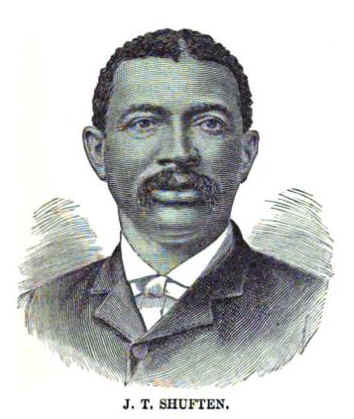
Baltimore, Md., or to J. T. Shuften, Augusta, Ga.
Before proceeding to comment respecting the work of The Colored American, it may
be interesting to know the cause of the establishment of The American by the two
gentlemen who signed the Prospectus
:
In May, 1865, when the United States Commissioner was sent South to the
freedmen, Mr. Shuften, then a very young man, was chosen to deliver the address
of welcome. He did so and acquitted himself nicely. He was followed by Rev. Dr.
Lynch of Baltimore, one of the leading lights of the Afro- American race.
Mr. Shuften saw the necessity of newspapers as the herald and sentiment of the
Afro-American, in connection with the work of elevating his people. Being a
young man of no great influence, — certainly not enough to give that prestige
to a publication necessary to draw about it a support, he succeeded in securing
the aid of Dr. Lynch. In September. 1865, he purchased type from a Mr. Singer
and issued the above Prospectus for a publication in October. The first week of
that month marked the issue of The American, the first Afro- American newspaper
published in the South, after the war. It was received with great favor, by both
white and black citizens; and heartily endorsed by the people of Augusta for its
good and timely counsels, under the new order of things.
It had no politics to advocate at that time ; for its advent was before the
enfranchisement of the Afro-American, or the ratification of the Fifteenth
Amendment. It therefore had nothing to promote but the intellectual and moral
advancement of its constituents, which it did to no little extent. The American
had but one exchange upon its file, — that of The Colored Citizen, published
at Cincinnati, Oh.
The American had but a brief existence. Mr. Shuften having consented to form
a joint-stock company for the purpose of placing the paper upon a more permanent
basis, he was forced, in February, 1866, through the bad faith of the
stockholders, to abandon the enterprise to its creditors. It was purchased by
Mr. J. E. Bryant and afterwards appeared under the name of The Loyal Georgian.
The American, during its career, received valuable support and encouragement
from Bishop H. M. Turner and Rev. Dr. James Lynch. In fact, Mr. Lynch did a vast
deal of good by writing for the paper, which made it a journal of interesting
matter. He was not only a man of great experience but of vast learning, and was
a ready writer.
Says an eminent man : " Lynch's articles were always carefully prepared,
thoughtful, argumentative, and convincing; and they performed a good work
wherever read." Another says: " Mr. Shuften was a writer of natural
ability."
He has issued several pamphlets, and, at present, has a work of fiction prepared
for the press, which is entirely original. The New York World and Churchman
credits Mr. Shuften as the author of the best article yet published on the
" Negro Question."
He was born in 1840, in Augusta, Ga., and at present is a successful, practicing
lawyer, at the bar of Orlando, Florida,
The Afro-American Press and Its Editors by Irvine Garland Penn - 1891